
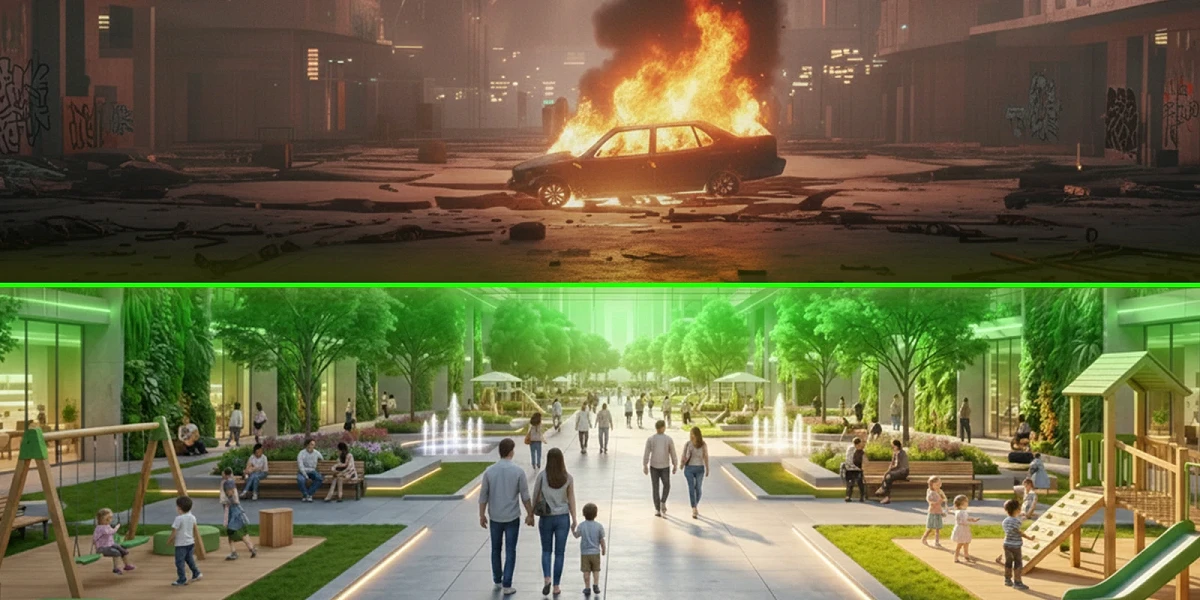
What kind of world are we enabling with our consumption decisions? From narcoculture to tech monopolies, a reflection on ethics and persistence.
Every consumption decision is a vote for the survival of the system that produces it. This applies equally to narcoculture, to technology monopolies, and to B2B vendors who sell dependency disguised as service. Ethical coherence — between what a company says it is and what it actually does — isn't an abstract value: it's the most solid infrastructure that exists for building sustainable businesses.
The recent events of violence that have shaken our environment force us to look beyond the surface. At Núcleo Studio, we usually talk about the Brand Gap in business, but today I want to talk about a deeper gap: the gap between our outrage and our participation.
When we consume narcoculture —whether through music, series, or aesthetics— we're doing much more than "entertaining ourselves." We are, quietly but forcefully, validating a business model, an identity, and a lifestyle based on social disintegration. By consuming, we grant implicit permission for that reality to persist over time.
To Consume Is to Validate
Every time we hand our attention or our money to a system, we're voting for its survival. This applies both to groups that operate outside the law and to corporations that dominate global markets. If an unethical company manages to survive for decades, it isn't only because of its strength, but because the market (us) has decided that immediate benefit or entertainment justifies the moral cost of the system that sustains it.
In the B2B world, this dynamic often disguises itself as "technical necessity" or "industry standard," but the root is the same: the validation of a business model that thrives thanks to client dependency.
The IBM Case and the End of Legacy Abuse
A fascinating example of how technology can break business models based on forced persistence is what's happening with IBM. For decades, a massive part of its resources came from maintaining critical legacy systems at banks and giant corporations. These companies were trapped in a technical monopoly; IBM was the only one capable of supporting obsolete but vital systems.
With the arrival of generative Artificial Intelligence, that "monopoly abuse" model began to crumble. AI has allowed end clients to understand, migrate, and optimize those systems without depending on a giant's technical bureaucracy. The drop in the perceived value of these operations isn't just a market adjustment; it's the end of a permission that clients are no longer willing to grant.
Ethics as the Infrastructure of the Future
As we mention in our analysis of identity with purpose, branding and business aren't cosmetics; they're the soul of the company. Today, ethics matter more than ever because they will define the world we live in for the rest of our days.
At Núcleo Studio, we believe in Technical Honesty as a form of resistance. It isn't about appearing good, but about being coherent. If we build brands and web systems that prioritize clarity and real value over deception or dependency, we're enabling a business ecosystem where integrity is profitable.
Closing reflection: Are we designing bridges toward a more honest future, or are we simply feeding monologues that validate broken systems?
A Commitment to Clarity
Coherence isn't a state, it's a daily practice. Defining which business model you want to validate today is the most political and ethical decision you can make as a company leader.
- Schedule a Coherence Audit: We'll review whether your brand and your operation are aligned with the values you want to project.
- Let's Talk About Integrity: If you're looking to build real trust infrastructure, message me directly on WhatsApp.
Conversation