
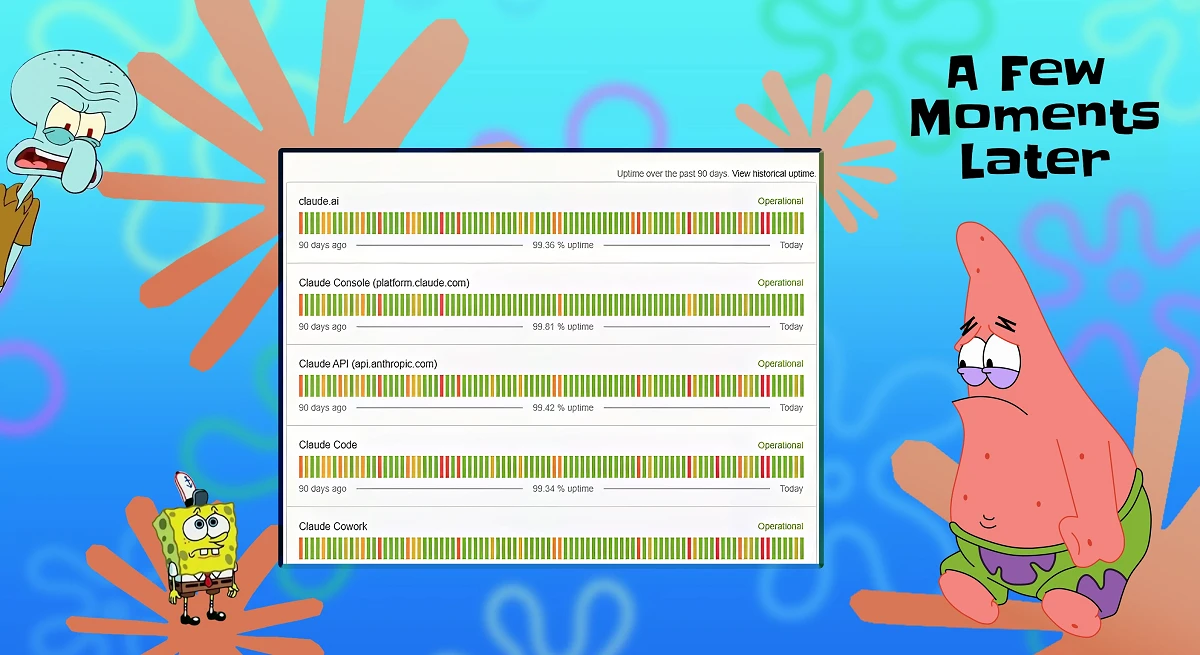
Anthropic's status page has more failures than I've seen on any critical infrastructure provider. It's the clearest signal that AI platforms are overloaded — and a concrete reason to have visibility into the uptime of your own services.
Anthropic's status page — the company behind Claude, one of the world's most widely used AI models — shows something I've never seen before on any critical infrastructure provider: a quantity of failures and interruptions that turns their uptime history into a permanent orange and red traffic light. claude.ai: 99.36%. Claude API: 99.42%. Claude Code: 99.34%. Numbers that sound fine until you calculate what they mean in real downtime.
And this isn't an attack on Anthropic. It's a signal of something bigger happening across the entire industry.
What does 99.36% uptime actually mean?
The nines in uptime matter. The difference between 99% and 99.9% isn't marginal — it's an order of magnitude:
| Uptime | Downtime per year | Downtime per month |
|---|---|---|
| 99.9% ("three nines") | 8.7 hours | 43 minutes |
| 99.5% | 43.8 hours | 3.6 hours |
| 99.36% | 56 hours | 4.7 hours |
| 99.0% | 87.6 hours | 7.3 hours |
claude.ai at 99.36% uptime means nearly 56 hours of downtime per year. More than two full days where the service was unavailable — or degraded — in the last 90 days alone.
For an entertainment service, that's tolerable. For a tool that product teams, developers, and companies have integrated into their daily operations, that's a real operational problem.
AI platforms are overloaded — and it's showing
It's not just Anthropic. It's the symptom of an entire industry that grew faster than its infrastructure can sustain.
OpenAI had repeated major incidents in 2024 and 2025. Google Gemini has had documented service degradations. Cloud GPU providers — the scarce resource that feeds all these models — report waitlists for additional capacity.
AI demand growth is exponential. Infrastructure capacity grows linearly. That gap manifests exactly as shown in the image: a status page full of outages, degradations, and incidents that become the norm instead of the exception.
As we analyzed in our post on how AI is breaking the internet's economic contracts, AI platforms are redefining expectations on every front — including availability and reliability.
Uptime as a business metric — not just an engineering one
There's a widespread belief that uptime monitoring is a DevOps problem. Something the technical team solves with an internal tool that the rest of the company doesn't need to see.
That belief is expensive.
When your website goes down, you don't find out from your technical team — you find out because a client sends you a message asking what happened, or worse, because you discover three days later that you were down for hours without anyone noticing. When the API your product depends on fails, your users experience errors they attribute to your product, not the underlying provider.
Uptime visibility isn't a luxury for enterprise companies with formal SLAs. It's basic information that any business that depends on its digital presence needs to have — in real time, without having to go looking for it.
Three questions every B2B website should be able to answer right now
- How much time was your website down last month?
- How long did it take you to find out the last time there was an outage?
- Which prospects tried to contact you when your contact form wasn't working?
If you can't answer these questions, you have no visibility into a risk that is happening right now, in real time, as you read this.
I built it because I needed it — and decided to do it in Golang
A few weeks ago I identified that I needed an uptime monitoring tool for my own projects and my clients'. The existing options are either too complex, too expensive for what a mid-sized B2B company needs, or both.
So I built it. In Golang — a language I had zero practical experience with — in two days. With hexagonal architecture, goroutine-based concurrency, WebSockets for real-time updates, and deployment on Oracle Cloud ARM64.
The result is ATBaby.online: an uptime monitor that checks the availability of your servers and websites, records incident history, and notifies you when something goes down. No unnecessary complexity. No enterprise pricing for basic functionality.
And it has a detail I find relevant given this post's context: you can embed the status of any server directly on your website with a single line of HTML. If your infrastructure is operational, your visitors see it. If there's an incident, they see that too.
Uptime transparency as a trust signal. Exactly the opposite of what we see in the image that opens this post.
The irony that closes the argument
I'm using an uptime monitor built in two days to watch the same AI services whose instability inspired this post. claude.ai appears in my ATBaby.online dashboard alongside my clients' sites.
When Claude goes down — and it does — I know before my clients notice. That's operational visibility. And it's what any business that depends on its digital presence should have for their own services.
Conversation