

The industry is predatory because the people in it operate from fear and scarcity. And your real values — not the ones you declare — filter directly into your business without you deciding it. An honest reflection on resilience, the zero-sum game, and why building a better business starts with becoming a better person.
The design, marketing, and digital services industry is predatory not for lack of regulation or absence of declared ethics — but because it's full of people operating from fear, scarcity, and competition understood as a zero-sum game. And the uncomfortable part is this: you've probably done it too. So have I. The mechanism isn't intentional — it's the direct reflection of who we are when we're under pressure.
Your real values aren't the ones you declare — they're the ones visible under pressure
There's a gap between the values a company declares and the values it actually operates by. That gap isn't necessarily hypocrisy — it's unconsciousness. Entrepreneurs build businesses that reflect their inner world without realizing it's happening.
When a client asks for a discount you can't sustain, the answer you give reveals something about your relationship with scarcity. When you see a competitor do something dishonest that works, the temptation you feel reveals something about your relationship with security. When money runs short and there's an opportunity to cut a corner, the decision you make reveals something about your relationship with integrity under pressure.
Those decisions, made over and over again, build the culture of the business. Without a plan. Without a strategy. Without having intended it. Just as the echo of who the person behind the project is.
If you operate from fear, your business operates from fear. If you have a toxic relationship with scarcity, that relationship filters into how you structure your proposals, how you treat clients when something goes wrong, how you respond when a competitor wins the project you wanted. Not because you decided it — but because it can't be any other way.
Why the industry stays predatory
The zero-sum game — the idea that for me to win someone has to lose — isn't a market reality. It's the projection of a mindset. And when enough people in an industry operate from that mindset, it becomes the norm.
A designer who sees another designer as a threat instead of someone solving different problems for different clients — is competing for a fixed pie instead of contributing to making the pie grow. An agency that sells clients what they want to hear instead of what they need to know — is prioritizing short-term revenue over the long-term relationship. A vendor who withholds access and generates artificial dependency — is operating from scarcity disguised as strategy.
None of these behaviors require the people involved to be bad. They just require that those people haven't resolved their relationship with fear, scarcity, and the need to win at others' expense in order to feel secure.
The 48 Laws of Power: a manual for maintaining the corrupt system
Robert Greene published The 48 Laws of Power in 1998 as a historical and descriptive study of how power dynamics operate in royal courts, wars, and corporate hierarchies. Not as an instruction manual. As a warning.
But most people who read it treat it exactly as that: a manual. A collection of tactics for winning at others' expense — manipulate, conceal intentions, crush rivals before they become threats. A kind of secular bible of success for those who feel the world is a battlefield and others are obstacles or resources.
The problem isn't the book. The problem is the mindset it attracts — and the one it reinforces.
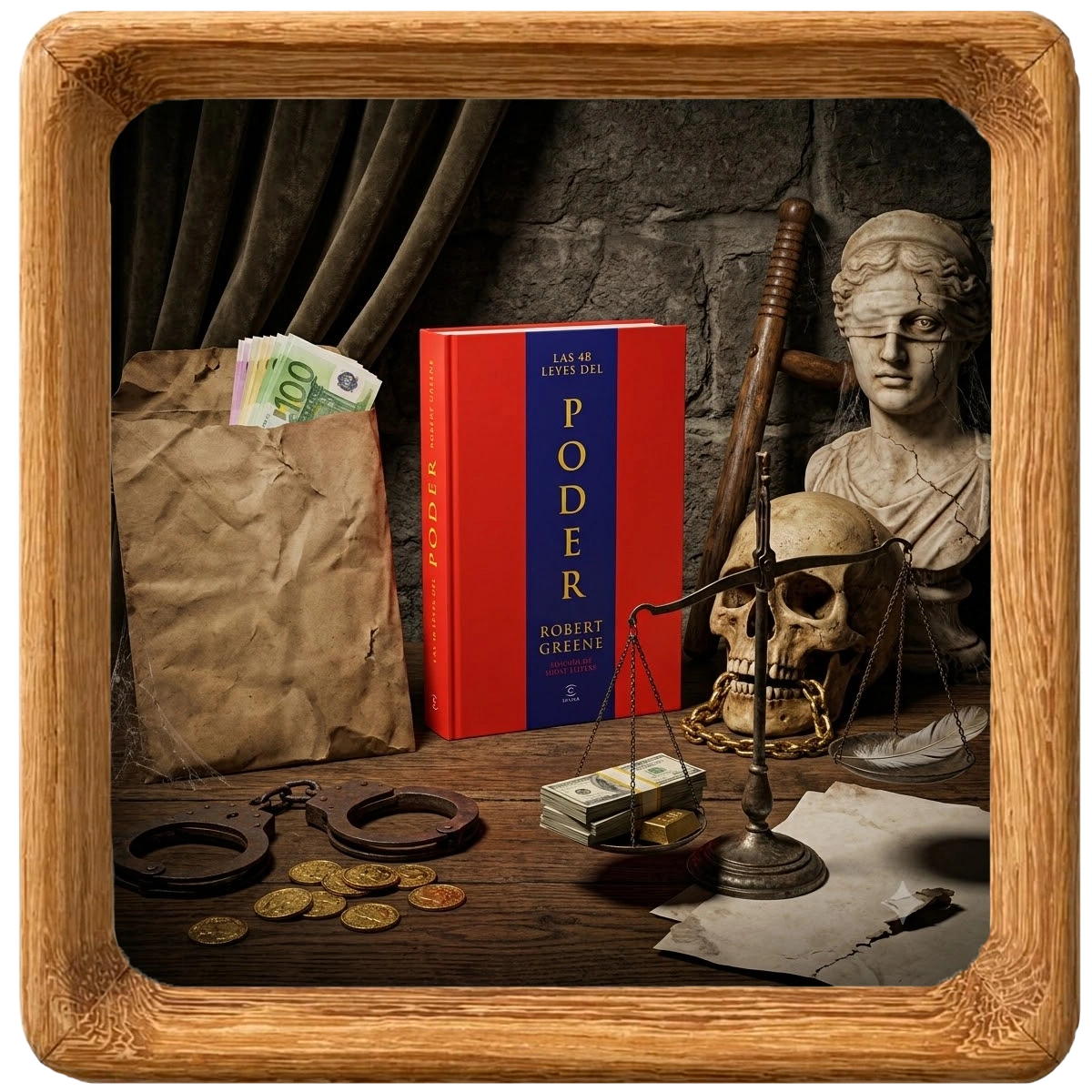
The 48 Laws only work in an environment of fear and scarcity. They're tactics designed to operate in systems where trust is naive, where showing vulnerability is suicidal, where the only move is to dominate before being dominated. If you apply them successfully, you haven't gained power — you've confirmed that the environment you operate in is exactly that: one where trust is impossible and cooperation is a trap.
And most tellingly: many of the historical figures Greene analyzes in the book ended up alone, betrayed, or destroyed by the same mechanisms they used to rise. Power accumulated at the cost of trampling on others doesn't build anything sustainable — it builds a system where everyone around you is waiting for the first opportunity to give you exactly the same treatment.
Believing the 48 Laws are the path to success isn't a business strategy. It's the confession that you haven't found another way to feel secure than controlling those around you. And that, like everything in this post, isn't a strategy problem — it's a personal one.
The only reason Núcleo Studio still exists
I won't romanticize this: there have been moments where the economic horizon wasn't visible. Where the simplest logic would have been to close, find a job, do anything else that generated more predictable income.
What kept the business going wasn't a pivot strategy or a model change. It was resilience — understood not as forced positive attitude but as the real capacity to find ways to adapt when the original path doesn't exist, to search for solutions where previously there were only dead ends, to not close off to opportunities that weren't exactly what had been imagined.
That's a personal value. One you don't learn in a course — you work for it, lose it, recover it. And that value is exactly what determines how I treat clients when a project gets complicated, how I structure proposals when the budget is tight, how I respond when something goes wrong.
Not because I designed it that way. But because the business is the mirror of the person who builds it.
The exit from the zero-sum game isn't a strategy — it's personal work
The industry doesn't change with better contracts or more regulation. It changes when the people who make it up stop operating from fear.
When someone has done enough personal work to not need to exploit others to feel secure, their business decisions change naturally. Not because they're more ethical in the abstract — but because they no longer need to be predatory to survive.
That translates into concrete things: telling a client when their project isn't what they think it is, even if that means losing them. Recommending a competitor when the work they're looking for fits their profile better than yours. Structuring prices that are sustainable instead of ones that close the project today but generate resentment tomorrow.
None of those decisions are altruism. They're the natural result of operating from a place of sufficiency instead of scarcity.
The most important work I've done for the business didn't happen in front of a computer
It happened in the moments where I had to decide what kind of person I want to be under pressure. And that decision, made over and over again, is what builds the kind of business you have — whether you want it to or not, whether you plan it or not.
If you want a better business, you have to be a better person. Not in the sense of nobler or more generous — but in the sense of more self-aware, more honest with yourself, and less afraid of scarcity.
I don't have a formula for that. What I do know is that the first step is recognizing the mechanism: that what you are filters into what you build, without asking your permission.
There's a question that makes that recognition harder to evade: what kind of person do I want to have been when I'm no longer here? It's the most uncomfortable question that exists — and the most clarifying. I'm building a tool to make it easier to answer. It's called Memento Vault.
Memento Vault: confronting mortality as a tool for clarity
Memento Mori — remember that you will die — is not an invitation to nihilism. In its original Stoic sense, it's exactly the opposite: a catalyst for urgency and clarity. Knowing that time is finite forces you to prioritize what values you want to embody today, what stories you want to have lived, what kind of person you want to have built.
Memento Vault is a digital sanctuary to document that process. An active life optimizer that starts from a simple premise: if you knew exactly how much time you had left, what would you do differently today?
The heart of the application is the Stoic Clock — a visual matrix of your life in weeks, inspired by Tim Urban's work, with a central metric: the approximate days you have left based on life expectancy. It's not a medical figure. It's a mirror.
Around that clock, Memento Vault has a guided legacy capture system — questions organized in five categories: your tastes and essence, the stories you've never told, your aesthetic instructions for whoever comes after, capsules of wisdom, and critical messages for the people who matter. Responses can be captured by voice or text. The legacy is organized into a book of life by chapters, exportable, with designated guardians and time capsules with unlock dates.
The functional prototype is available now. If the argument in this post resonated with you — if you recognize the mechanism of operating from fear or scarcity — this is the tool that makes that conversation with yourself more concrete and more urgent.
Stack: Next.js 16 + TypeScript + Claude API + Gemini API + Tailwind CSS v4 + Supabase. Actively in development.
Conversation