
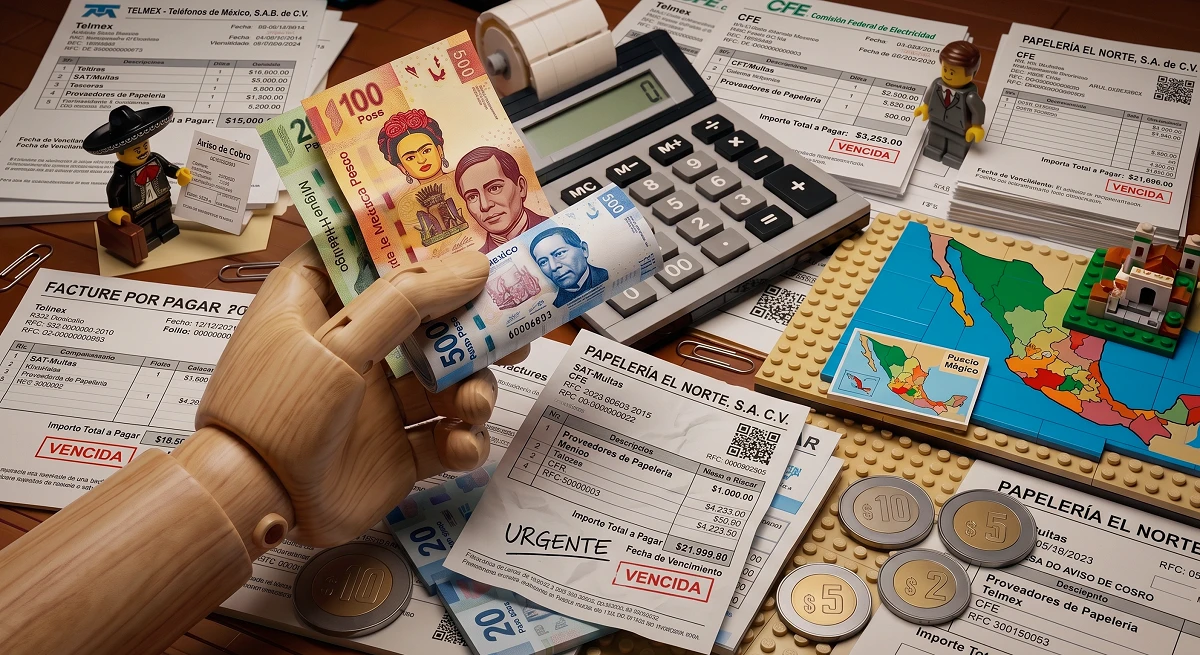
The cost of operating without a system almost never shows up on a P&L. Here's how to calculate it in real pesos — and why it's usually more than you think.
No P&L has a line that says "cost of not having a system." That's exactly why it's so easy to ignore: there's no ugly number to point at, just a vague sense that things take more effort than they should. But the cost is real, and it's almost always higher than the founder imagines.
You don't need bad decisions or bad faith to end up here. It's enough for a business to have grown faster than its structure — which happens to most businesses that are actually working.
The four most common leaks
1. Expensive hours spent on cheap tasks
When the founder — or their most expensive team member — spends hours copying data from one place to another, answering the same WhatsApp question, or building a quote by hand, that time has a real opportunity cost: it's time not spent selling, deciding, or doing the one thing that actually needs their judgment.
2. The error that slips through
A data point copied wrong onto a quote. A price that didn't get updated in one place. A delivery date promised without checking the real calendar. Each of these has a direct cost — a discount that has to be offered, an angry client — and an indirect one: lost trust.
3. The client who leaves without complaining
Not every client complains before they leave. Many simply stop replying after waiting too long for an answer. That lost revenue never shows up as "lost to slow operations" on any report — it just shows up as a month with fewer sales than expected.
4. The founder who can't disconnect
This one is the most expensive and the hardest to put in numbers: the cost of a business that can't run without its owner on top of every detail. That's not just personal burnout — it's real risk. A business that depends entirely on one person has no way to grow, and no cover if that person gets sick, takes a vacation, or just needs a day off. We looked closely at that operational ceiling in why your business can't grow any further, even though it's making good money.
How to run the numbers, even roughly
You don't need accounting-grade precision for this to be useful. Just estimate:
- Hours per week you or your team spend on repeatable tasks a system could do on its own.
- Multiplied by what that hour is worth if spent on what actually generates value.
- Plus an honest estimate of how many clients per month are lost to slow replies or process errors.
Most businesses running this exercise for the first time land on a number that makes them uncomfortable — not because it's miscalculated, but because they'd never put it into a single figure before. And a number, unlike a vague feeling, can actually be fixed. If you'd rather have a more precise read than a back-of-envelope estimate, we can walk through it in an operational diagnosis.
Conversation