
Fiscal year-end is approaching. Is your industrial website ready? Learn how to audit its ability to capture B2B leads in Guadalajara before December.
The Final Quarter: Is Your Website an Asset That Generates Leads, or a Liability That Repels Them?
Fiscal year-end in Guadalajara has a rhythm of its own. Budgets get defined, asset performance gets evaluated, and growth for the next cycle gets planned. In this process, many general directors in the industrial and professional services sectors review machinery, staff, and finances, but skip over a critical piece of their commercial operation: their website.
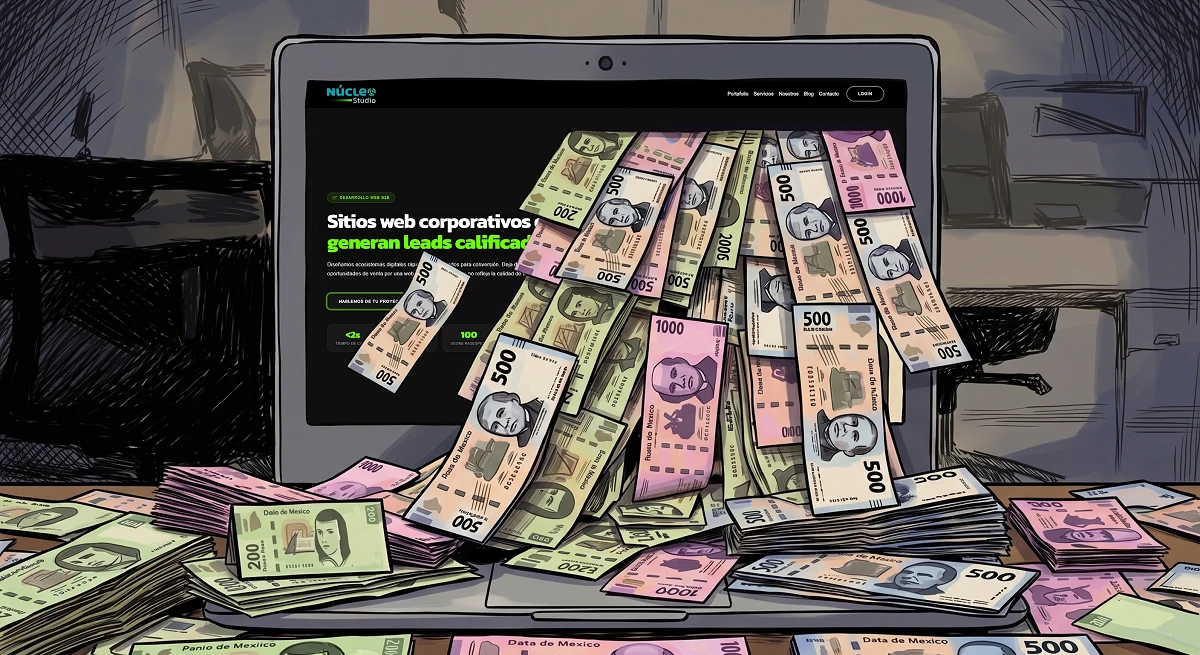
A B2B website isn’t a digital brochure. It’s an operational tool designed for one purpose: generating qualified prospects. If, at this crucial point in the year, your website isn’t feeding your sales funnel, it isn’t an asset — it’s a sunk cost and an obstacle to growth. Running an internal audit now, before planning wraps up, gives you the clarity to make corrective decisions and start next year with a demand-generation machine, not digital dead weight.
This is a straightforward audit guide, free of unnecessary jargon, to help you evaluate your website’s real capacity to attract the type of client your company needs.
Quick Audit Guide for B2B Directors
Spend 30 minutes running through these points. The answers will give you a clear diagnosis of the health of your main digital asset.
1. The Clarity Test: Is It Clear What You Do in Under 5 Seconds?
Open your site’s homepage. An industrial prospect or a consulting director doesn’t have time to decode corporate metaphors. They need to immediately understand three things:
- What you offer — Do you sell machinery, legal consulting, logistics services?
- Who it’s for — Is your market agribusiness, corporate legal, heavy manufacturing?
- What problem you solve — Do you increase efficiency, reduce legal risk, optimize the supply chain?
If your value proposition isn’t obvious and instant, you’re losing 90% of your qualified visitors. Ambiguity is the number one repellent of B2B leads.
2. Conversion Friction: How Hard Is It to Contact You?
A prospect has decided you’re worth pursuing. Now, the path to becoming a lead needs to be direct and free of obstacles. Check every possible point of contact:
- Contact forms — Are you asking for more than 4-5 fields? Every extra field lowers your conversion rate. Are you asking for a tax ID or full address on first contact? Cut it. Deep qualification happens later, not upfront.
- Phone numbers — Are they visible in the header and footer? On mobile, can visitors tap to call directly?
- Calls to action (CTAs) — Do your buttons say “Submit,” or do they say “Request a technical quote,” “Schedule a demo,” “Talk to a specialist”? The copy should reflect the value the prospect gets, not the technical action they’re performing.
If an engineer or a lawyer has to search for more than 10 seconds to find how to contact you, they’ve already moved on to your competitor.
3. Essential Technical Performance: Speed and Responsiveness
You don’t need to be a software engineer to evaluate this. A potential client’s patience is inversely proportional to how slow your website is.
- Load speed — Use Google’s PageSpeed Insights tool. Enter your URL. If your site takes more than 3 seconds to load its main elements, you’re losing business. A slow site reads as unprofessional and untrustworthy.
- Mobile experience — Over 50% of B2B traffic already happens on mobile devices. Open your site on your phone. Is the text legible without zooming? Are buttons easy to tap with a thumb? Is the menu navigable? If the experience is poor, you’re invisible to the director reviewing vendors between meetings.
4. Consistency and Technical Honesty
This is the most critical point, and the most often ignored. Your website should be an exact reflection of your operational capacity. Technical Honesty isn’t a slogan — it’s a credibility strategy.
Review your services pages and your marketing promises. Do you claim “nationwide coverage” when your logistics operation is really only strong in the Bajío region? Do you promise “24/7 support” when your technical team works regular office hours? Are you using stock photos of foreign workers instead of showing your actual team at your Guadalajara plant?
Any gap between your digital messaging and your operational reality destroys trust. A B2B prospect values predictability and evidence over inflated promises.
From Audit to Action: What’s Next?
By the end of this review, you’ll land on one of two conclusions:
- Your site has minor leaks: You may need to rewrite some copy, simplify a form, or compress images. These are fixes you can delegate internally, or handle with minor adjustments.
- Your site has structural problems: Slowness is a symptom of poor construction, lack of clarity is a strategy problem, and distrust is a branding failure. These issues don’t get solved with “patches.”
An industrial or professional services website isn’t an expense — it’s an investment in your sales machinery. If your audit reveals fundamental problems, year-end is the perfect moment to allocate the resources for a proper technical rebuild. This isn’t about changing colors; it’s about reconfiguring a business tool so it does its job: attracting and converting the clients you need to grow next year.
Conversation